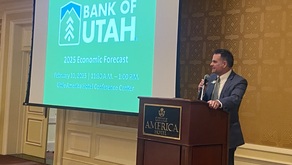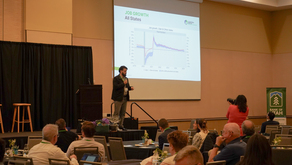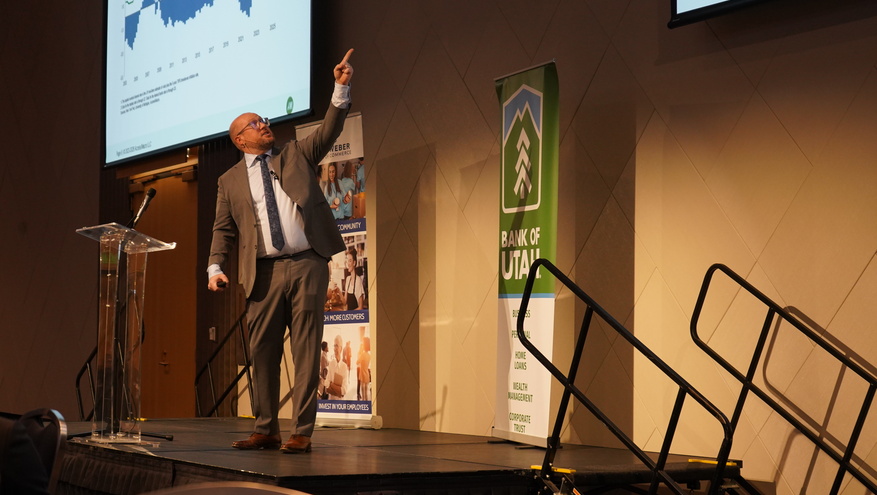
This year’s Bank of Utah Economic Forecast Event featured Tim Mahedy, Founder and Chief Economist of Access/Macro, and was held in Kaysville, Logan, Lehi, Ogden and Salt Lake City. Additionally, Michael Jeanfreau, a Senior Economist at the Department of Workforce Services, joined Mahedy and presented in Ogden and Kaysville. While uncertainty permeates the economic and political climate, consumers and businesses can find a lot to be optimistic about in 2026.
The national outlook for 2026:
Mahedy focused on three economic factors for 2026: consumer spending, inflation and monetary policy.
Click here to download Tim Mahedy's slides
Click here to download Michael Jeanfreau's slides
Consumers have been resilient amid tariff chaos: It would be easy to understand if they had frozen spending last year amid the enactment of tariffs. Yet consumer spending was a major driver of the economy, and while lower in the earlier part of the year, it continued to increase, with good numbers expected in the Q4 report. Understandably, with tariffs looming at the end of Q1, both imports and investment surged as firms tried to get ahead of the new rules. Those pre-emptive moves distorted GDP—net exports were a large drag in Q1 and then reversed in Q2, creating a GDP graph unlike those of any previous years.
The pace of inflation is easing, but not quite on target: The pace of inflation is slowing and may be inching closer to the vaunted 2% mark, yet overall inflation did not make any real progress in 2025, remaining the same from Q4 2024 to Q4 2025. Mahedy pointed out that tariffs should have led to higher inflation, but because corporate profits have been very strong, companies have been able to absorb much of the price increases. Inflation will still be an issue in 2026 and probably won’t reach the 2% goal—there could even be discussion about whether 2% is attainable—although the Fed believes 2% inflation could be achieved in 2027.
Monetary policy may be neutral in 2026, yet policymakers’ opinions are as diverse as ever: Mahedy noted that while the Fed’s monetary policies of the last few years—at least from a data/prediction standpoint—should have triggered a recession. Similar rate structures in the past have. Yet, the economy seems to have handled it, with the spread between the Federal funds rate and the implied nominal rate approaching zero. This means that the Fed may not do much with rates in 2026. While it seems the Fed board would be aligned with this result, the variance of opinions on when to end rate changes is as wide as ever, according to the FOMC forecast data. This huge range could portend an interesting year for Fed policy.
Mahedy suggested there may be a structural shift from the past 40 years of the Fed. An interesting outlier occurring in monetary policy is that for the past 40 years, the 10-year Treasury and federal funds rates have increasingly decreased; the last four years have bucked that trend, meaning potential homeowners may not see 2-3% interest rates for quite some time because 10-year Treasury bonds have spiked and stayed high.
Utah continues to outperform national metrics; yet the labor market is cooling, and housing is a major issue
Jeanfreau discussed Utah’s economy, with some emphasis on northern Utah.
Utah ranks higher than the U.S. in most economic metrics: Overall, Utah continues to outperform the rest of the nation in job growth, unemployment rate, education and economic diversity. For years, Utah was the fastest-growing state in the nation. It’s now No. 5. Some major shifts are on the way. Utah’s fertility rate, while still higher than the U.S. average, has gone below the replacement rate (the number of births that would replace the aging labor pool) of 2.1. This means newer generations won’t be able to facilitate job growth in the state. While this is a major concern, Utah is about 20 years ahead of much of the U.S.
Housing costs are ‘severely unaffordable’ in Utah: Jeanfreau discussed the impacts of high housing costs on the economy and Utah’s future. Housing affordability is the biggest issue. Utah wages have not kept pace with housing costs, characterizing the median home price as “severely unaffordable,” according to national and state reporting agencies. Housing unit construction is nowhere near keeping pace. Only 50,000 units have been built in the first five years of this decade. At that pace, the number of housing units built would be about half of what was built over the previous three decades. The rental market is not providing much relief, Jeanfreau notes. Nearly half of renters are paying 40-50% of their income on their monthly payments.
Utah’s future has many bright spots: Utah has one of the most diverse economies in the nation, which means the state has a wide variety of industries contributing to GDP. If one industry or sector declines, a more diverse state can absorb those impacts. Jeanfreau points out that Utah remains the youngest state by far, with a median age of 32.4 compared with the U.S. median of 39.1, a factor that is a huge driver of job creation. Consumers in Utah are more positive about the future, with significantly higher numbers in Consumer Sentiment and Financial Situation Outlook measures.
Bank of Utah thanks its clients and partners who attended this year’s events and appreciates the insights of Mahedy and Jeanfreau, which will help guide business and investment decisions in 2026.